When The Economist ran a piece in August 2026 headlined "why standing at your desk may be little better than sitting," my inbox filled up. Clients who had just bought sit-stand desks wanted to know if they had wasted their money. The honest answer to the standing desk vs sitting question is not the one either side of the debate wants to hear: neither posture is the point. Movement is.
In a Hurry? Start Here
- Neither posture is the problem: the Sedentary Behaviour Research Network defines sedentary behaviour by energy expenditure (≤1.5 METs), so sitting still and standing still are closer than the debate admits.
- The benefits are real but modest: about 9 extra calories an hour and a small reduction in low back discomfort, mostly because standing makes it easier to break up sitting time.
- Movement beats posture: the Buckley et al. 2015 expert statement points to 2 to 4 hours of accumulated standing and light activity a day, plus movement breaks every 30 minutes, not to standing still for hours.
Table of Contents
Disclosure: TechDeskZone is reader-supported. When you buy through links on our site, we may earn an affiliate commission at no additional cost to you. See our affiliate disclosure for details.
The Headline That Started This
On 14 August 2026, The Economist ran a piece arguing that standing at your desk “may be little better than sitting.” Within a day it was everywhere, and most of the commentary stripped out every important caveat. The takeaway people walked away with was blunt: standing desks are a waste of money.
That is not what the evidence says, and I have spent the last week explaining why to clients. I have set up sit-stand desks for people who then stood for eight straight hours and came back a month later with aching calves and a fresh hatred of their new desk. I have also set them up for people who used them to switch position every half hour and felt their afternoon back stiffness disappear. Same desk. Different behaviour. The difference was never the standing itself.
This article is my attempt to lay out what the research actually says, including the parts that are uncomfortable for both camps. I will tell you up front what you will not find here: a clean verdict that standing is good and sitting is bad. What you will find is a clearer question, which is: how much time do you spend not moving at all, and what does the evidence say that costs you?
What Sitting Actually Does to Your Body
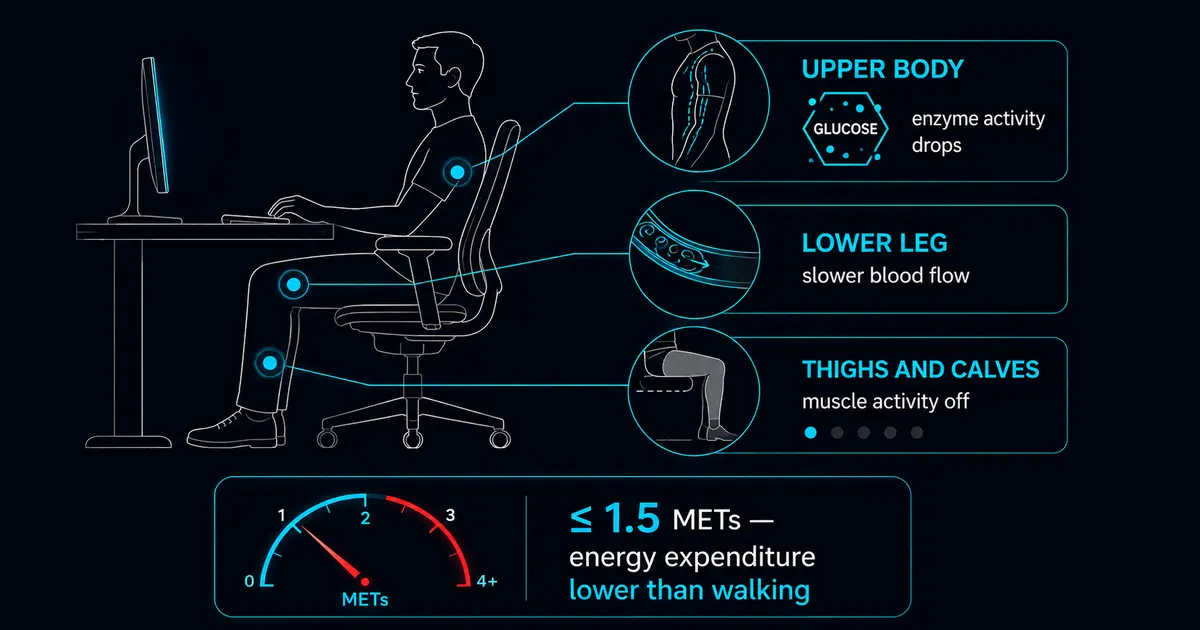
Before you can weigh the standing desk vs sitting question, you need to know what the researchers are actually measuring. They are not measuring chairs. The Sedentary Behaviour Research Network, the group whose definition the field uses, defines sedentary behaviour as “any waking behaviour characterized by an energy expenditure ≤1.5 METs, while in a sitting, reclining or lying posture.” The key word there is energy expenditure. Sitting still for an hour and standing still for an hour are closer than most people think, because neither asks your body to do much work.
What makes prolonged sitting a problem is not the shape of your spine. It is what goes quiet. When you sit, the large muscles in your legs stop contracting, blood flow through your lower limbs slows, and the enzymes that clear glucose and fat from your bloodstream become less active. This is the mechanism behind the finding that breaking up sitting time improves glucose and insulin responses, which I will come back to. None of this is about whether your chair is expensive.
The mortality numbers get thrown around a lot, so let me be precise. A 2015 meta-analysis in the Annals of Internal Medicine found that prolonged sitting was associated with a higher risk of cardiovascular disease, type 2 diabetes, and death, independent of how much moderate-to-vigorous exercise people did. That independence is the part worth paying attention to: you cannot fully gym your way out of twelve hours of chair time. But “sitting is the new smoking” has always been an exaggeration. Sitting is not as harmful as smoking per hour of exposure, and saying it is just makes people tune out. The honest version is this: long, unbroken sitting is a genuine health cost, and it stacks with, rather than replaces, the cost of not exercising.
The Real Standing Desk Benefits
If you came here for a list of standing desk benefits, here is the honest one. They exist. They are also smaller and more specific than the marketing suggests.
It Breaks Up Sitting Time
This is the benefit that actually holds up, and it is almost boring. A sit-stand desk makes it easier to interrupt long sitting bouts, because you do not have to leave your desk to do it. Research on real office workers backs this up: a 2019 scoping review in Applied Ergonomics pooled 53 studies of office workers and found that the behavioral effect is the reliable one: sit-stand desks do change how much people sit and stand, while health outcomes shift only mildly. The review notes that long-term effects are still under-studied. The desk is not the intervention. The position changes are.
Calories, If You Care
Standing burns more than sitting, but not much. A 2018 systematic review and meta-analysis in the European Journal of Preventive Cardiology put the difference at roughly 0.15 kcal per minute, which works out to about 9 extra calories an hour. Over a full workday of standing, that is somewhere around 50 to 70 extra calories. It is not nothing, but it is not a weight-loss strategy either. If you are standing to lose weight, you will be disappointed. If you are standing to avoid being completely still for nine hours, the same number is a side effect, not the point.
Back Discomfort, Modestly
The evidence on back pain is real but underwhelming. A 2018 meta-analysis in Ergonomics found sit-stand workstations reduced low back discomfort, but the effect was small, about a third to half a point on a ten-point pain scale. A 2018 Cochrane review of 34 studies found sit-stand desks cut workplace sitting time by about 100 minutes a day in the short term, though it could not reach firm conclusions on pain or other musculoskeletal symptoms because that evidence was too thin. What this means in practice: some people feel better alternating, some do not, and the studies average out to a modest signal. A 2025 scoping review reached a related conclusion: sitting behaviour, the habit of few breaks and long static sitting, was the factor most strongly linked to low back pain. If your back hurts, a sit-stand desk is worth trying, but it is not a treatment. My own clients who report the biggest improvement are the ones who also fix their sitting posture, which is covered in my chair ergonomics guide.
Circulation and Alertness
Standing increases blood flow and muscle activity in the legs relative to sitting, which is why people often say they feel more awake and less sluggish in the afternoon. The alertness effect is real and partly physical, but I would not overstate it. What most people describe as a “standing energy boost” is usually the effect of not having been motionless for two hours. A short walk does the same thing better.
Where Standing Falls Short
Now the other side, because the Economist piece was not wrong, just incomplete. Standing still for hours has its own costs, and pretending otherwise is how we end up with people trading one static posture for another and calling it a fix.
Prolonged standing is associated with muscle fatigue and pain in the lower back and lower limbs. A 2017 systematic review in Gait & Posture pulled the laboratory evidence together and confirmed the pattern: the longer the unbroken bout, the more the lower back and legs complain. Anyone who has worked a retail or service job already knows this from experience. Standing is not restful. It is a different kind of load.
There is a useful distinction in the literature here. When researchers compare sitting to standing, standing wins on a few markers like waist circumference and some blood lipids. When they compare sitting to walking or moderate activity, the gap is far larger. A 2015 study in the European Heart Journal found that reallocating two hours of sitting to standing moved a few biomarkers in the right direction by small amounts, while reallocating the same two hours to stepping moved weight, waist circumference and cholesterol markers much further. In other words, standing is the smallest possible upgrade from sitting. It is better than nothing, but only barely.
This is the truth hiding inside the Economist headline. If you buy a standing desk and use it to stand perfectly still for seven hours, you have not solved the problem. You have moved it from your hips to your feet. The research has been consistent on this for years, and the 2026 news cycle mostly served to remind people of a finding they had been ignoring: posture is not the lever. Movement is.
What the Research Actually Recommends
So what should you actually do? The clearest, most specific guidance comes from a single expert statement, and it is worth citing properly because the recommendation is precise enough to act on.
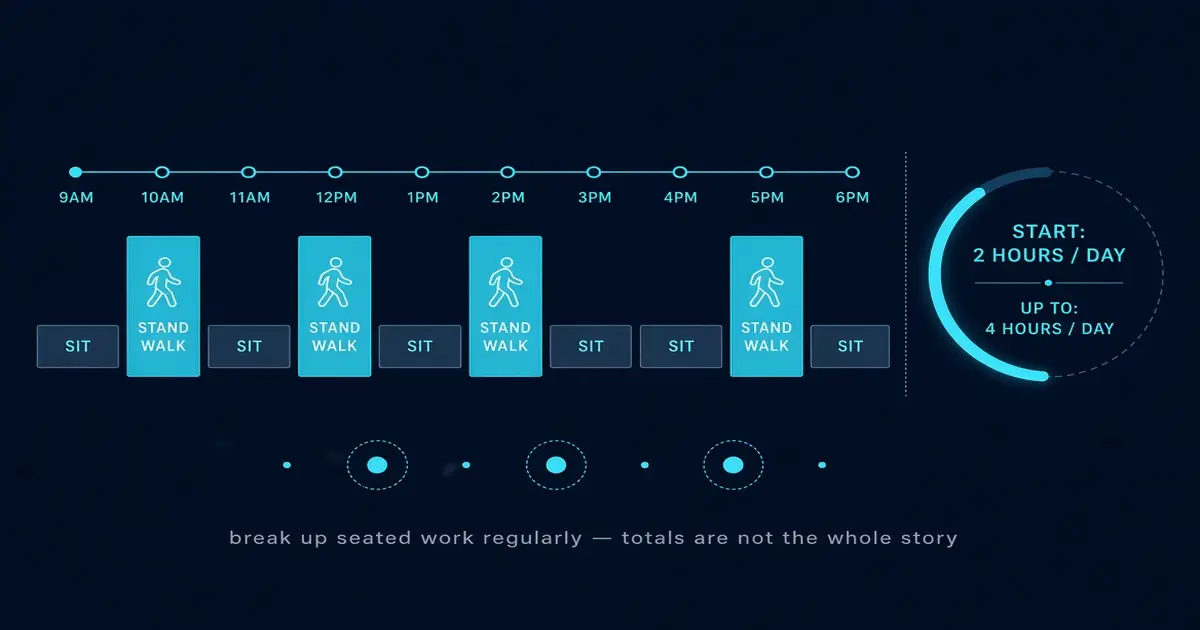
In 2015, a group of researchers including John Buckley and Alan Hedge published an expert statement in the British Journal of Sports Medicine commissioned by Public Health England. Their target for office workers: accumulate around 2 hours of standing and light activity during the working day to start, and work up to 4 hours a day. Note the framing. It is not “stand for 4 hours.” It is “accumulate 2 to 4 hours of standing and light activity,” where light activity includes walking, and the accumulation matters. They also recommended breaking up seated work regularly, because the total is not the whole story. How you distribute it is.
The micro-break research supports that. A 2012 study in Diabetes Care found that in overweight adults, walking for 2 minutes every 20 minutes significantly lowered glucose and insulin responses compared to uninterrupted sitting. A 2016 study in the same journal found that 3 minutes of light walking or simple resistance moves every 30 minutes had a similar effect. The pattern is consistent: the breaks do not need to be long or hard. They need to happen.
Put the two together and the recommendation stops being a slogan. Sit less, move more, and interrupt what sitting you do. Aim for 2 to 4 hours of accumulated standing and light activity across the workday, and interrupt whatever posture you are in every 20 to 30 minutes. That is the whole strategy. It is not complicated, and it does not require a £600 / ~$760 desk to follow.
How to Actually Use a Sit-Stand Desk
If you already have a sit-stand desk, or are about to buy one, here is how I set them up for clients so the desk earns its keep. You can read my full product breakdown in best standing desks 2026, but the usage pattern matters more than the model.
Start Short and Build Up
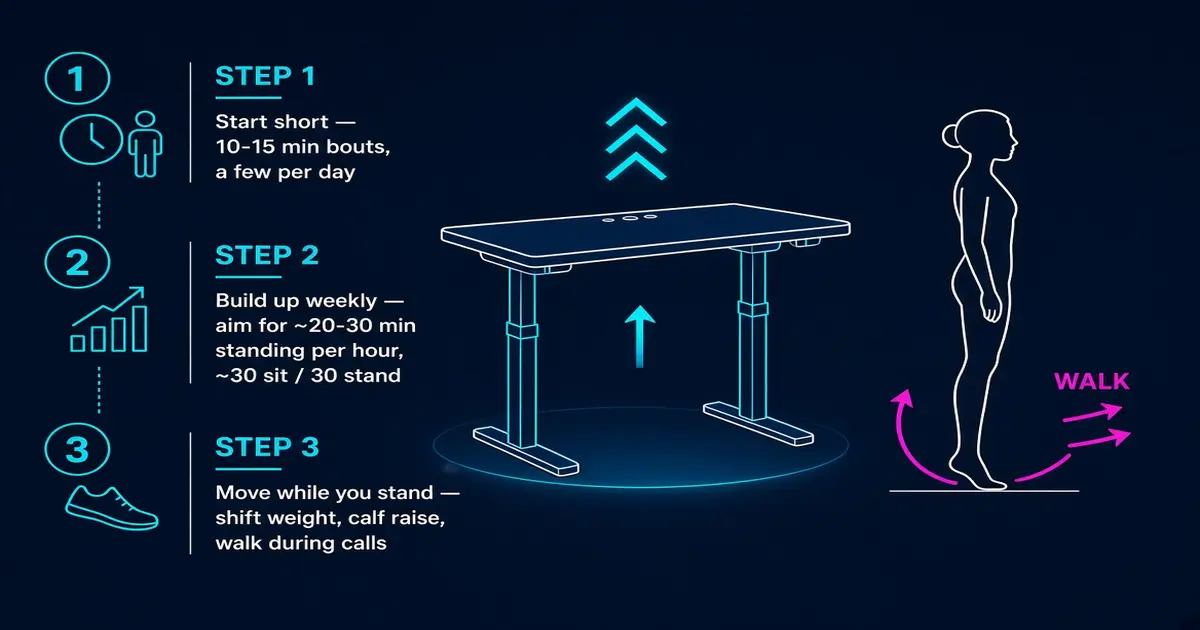
The biggest mistake is going from sitting all day to standing all day in one afternoon. Your calves, feet, and lower back are not ready for it, and you will quit within a week. Start with 10 to 15 minute standing bouts, a few times a day. Add a few minutes a week. Most of my clients land somewhere around 20 to 30 minutes of standing per hour, split roughly 30 standing and 30 sitting, and that is plenty.
Move While You Stand
This is the part almost everyone skips. Standing still is not the goal. Shift your weight, take a step or two, do a calf raise, walk during calls. The whole point of standing is that it makes movement easier than sitting does. If you stand like a statue, you have recreated the problem upright.
Get the Height Right
When you stand, your elbows should be at roughly 90 degrees with your forearms parallel to the floor, and the top third of your monitor should be at eye level. Most people set the desk too high and then crane their neck up, or too low and then hunch. This is the same setup logic as sitting, just at a different height, and it is why I wrote a separate guide on monitor height and neck pain. When you switch between sitting and standing, the desk and monitor both need to move, which is why the motorized desks with memory presets are worth the extra money if you will actually alternate.
Do Not Forget the Sitting Half
A sit-stand desk is only half a workstation. You still need the sitting side set up correctly, which means the same rules as any desk: chair height, seat depth, lumbar support, and neutral wrists. I cover the chair side in the chair ergonomics guide, and the keyboard and mouse positioning in my wrist pain prevention guide. The goal is a workstation where both postures are set up properly, so the only thing that changes when you alternate is whether you are sitting or standing.
Think of It as One Piece of a Bigger Setup
A desk does not fix a bad room, and posture variety does not fix a bad monitor. If you are building or rebuilding a space, treat the sit-stand desk as one decision inside a larger one, which is exactly the framing in my ergonomic home office setup guide. The desk gets the attention because it is the most visible purchase, but the monitor, chair, lighting, and keyboard all contribute, and getting any one of them wrong drags the whole thing down.
At the end of the day, the research keeps pointing to the same unglamorous conclusion. A sit-stand desk is a useful tool for one specific job: making it easier to change position and move more during a long workday. It will not rescue you from a sedentary job on its own. Used that way, as a way to interrupt sitting and move, it earns its place. Used as a place to stand still instead of sit still, it does not. If you want to skip the back-and-forth and just see which desks are worth buying, the full comparison is in best standing desks 2026.
Sources
- The Economist: “Why standing at your desk may be little better than sitting” (14 August 2026).
- Buckley J.P., Hedge A., Yates T., et al. “The sedentary office: an expert statement on the growing case for change towards better health and productivity.” British Journal of Sports Medicine. 2015;49(21):1357-1362.
- Tremblay M.S., et al. “Sedentary Behavior Research Network (SBRN) – Terminology Consensus Project process and outcome.” International Journal of Behavioral Nutrition and Physical Activity. 2017;14:75.
- Biswas A., et al. “Sedentary time and its association with risk for disease incidence, mortality, and hospitalization in adults.” Annals of Internal Medicine. 2015. doi:10.7326/M14-1651
- “Differences of energy expenditure while sitting versus standing: a systematic review and meta-analysis.” European Journal of Preventive Cardiology. 2018. doi:10.1177/2047487317752186
- Dunstan D.W., et al. “Breaking up prolonged sitting reduces postprandial glucose and insulin responses.” Diabetes Care. 2012. doi:10.2337/dc11-1931
- “Three minutes of light-intensity activity every 30 minutes improves glucose and insulin.” Diabetes Care. 2016. doi:10.2337/dc15-2336
- Chambers A.J., Robertson M.M., Baker N.A. “The effect of sit-stand desks on office worker behavioral and health outcomes: a scoping review.” Applied Ergonomics. 2019. doi:10.1016/j.apergo.2019.01.015
- Agarwal S., Steinmaus C., Harris-Adamson C. “Sit-stand workstations and impact on low back discomfort: a systematic review and meta-analysis.” Ergonomics. 2018;61(4):538-552. doi:10.1080/00140139.2017.1402960
- Shrestha N., Kukkonen-Harjula K.T., Verbeek J.H., Ijaz S., Hermans V., Pedisic Z. “Workplace interventions for reducing sitting at work.” Cochrane Database of Systematic Reviews. 2018;12:CD010912. doi:10.1002/14651858.CD010912.pub5
- Alaca N., Acar A.Ö., Öztürk S. “Low back pain and sitting time, posture and behavior in office workers: a scoping review.” Journal of Back and Musculoskeletal Rehabilitation. 2025;38(5):919-943. doi:10.1177/10538127251320320
- Coenen P., et al. “Associations of prolonged standing with musculoskeletal symptoms: a systematic review of laboratory studies.” Gait & Posture. 2017;58:310-318. doi:10.1016/j.gaitpost.2017.08.024
- Healy G.N., Winkler E.A.H., Owen N., et al. “Replacing sitting time with standing or stepping: associations with cardio-metabolic risk biomarkers.” European Heart Journal. 2015. doi:10.1093/eurheartj/ehv308
Medical disclaimer: This article discusses research on sedentary behaviour, sitting, and standing. It is not medical advice. If you have existing back pain, cardiovascular concerns, or any medical condition, consult a healthcare professional before making significant changes to your activity or workstation.
The Verdict
Bottom line: Standing vs sitting is the wrong question. Prolonged static posture in either position is the problem, and the research is consistent that movement and posture variety are what actually move the needle.
Quickest fix: Interrupt sitting every 20 to 30 minutes with a couple of minutes of walking or movement, and alternate between sitting and standing instead of standing still for hours.
Best permanent fix: A sit-stand desk used for variety, combined with the 2 to 4 hours of accumulated standing and light activity per workday that Buckley et al. (2015) recommend.
← Back to Ergonomics Hub