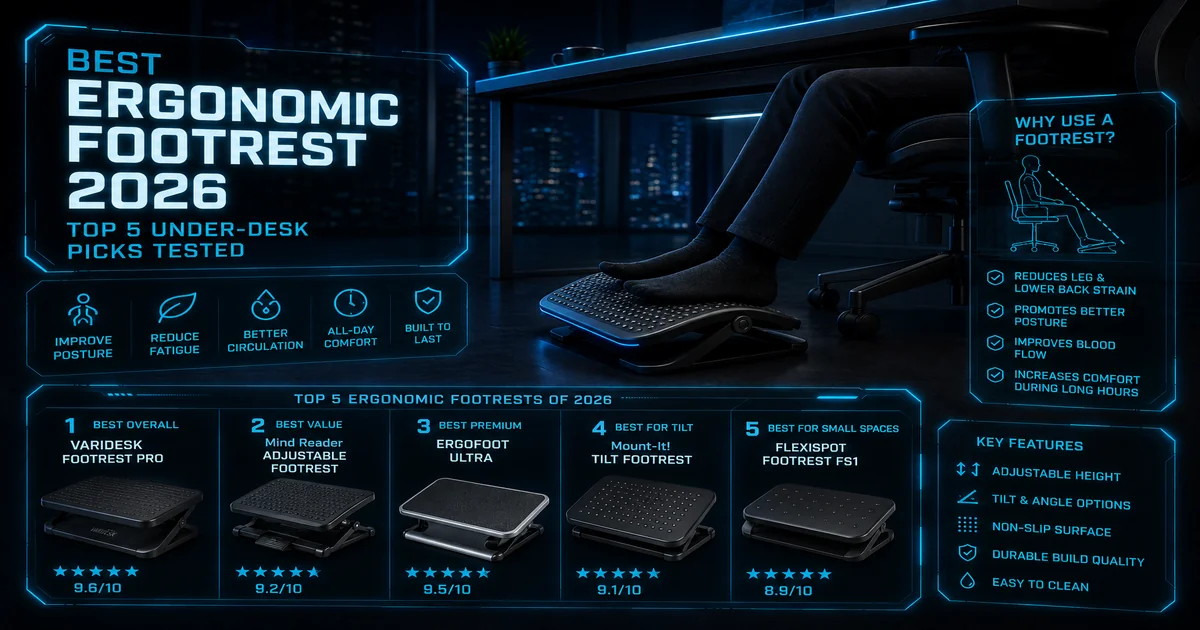
A footrest costs as little as $30 / ~£25, and it fixes a problem that chair height adjustment alone can't. Raise your chair until your elbows sit at desk height, the correct ergonomic position. Now look at your feet. If they don't rest flat on the floor, your thighs angle downward, your pelvis tilts forward, and your lower back rounds into flexion. That's not a posture habit. That's geometry. The Canadian Centre for Occupational Health and Safety is blunt about it: "Use a footrest if you cannot place your feet flat on the floor." OSHA says the same. A 2018 systematic review in Applied Ergonomics (Waongenngarm et al.) looked at how breaking up prolonged sitting affects lower back pain and discomfort in office workers.
In a Hurry? Start Here
- ComfiLife Adjustable Memory Foam Footrest ($35–60 / ~£35) is the best overall: Wirecutter's multi-year top pick, 13,900+ reviews at 4.6/5, two flip-adjustable heights, and a lifetime "no questions asked" warranty.
- Kensington SmartFit SoleMate Plus ($40–55 / ~£40) is the best adjustable platform: a hands-free pedal with 4 height positions on a 17.7" × 13" rigid deck, best for shoe-wearing office users.
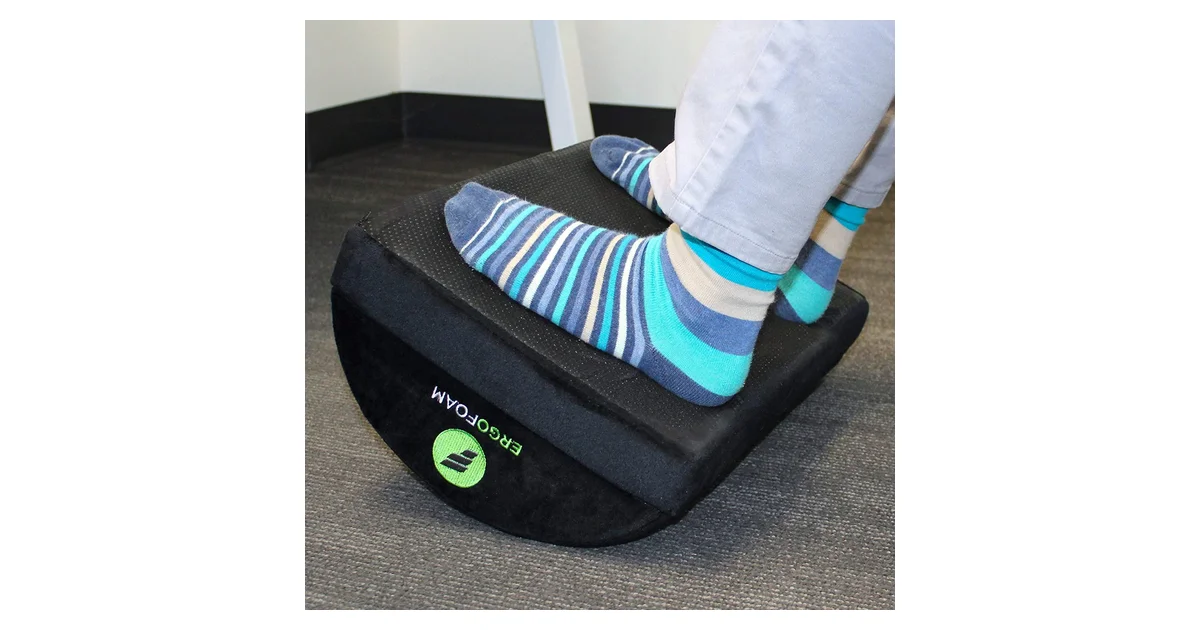
- Fellowes Foot Rocker ($25–35 / ~£25) has the largest platform at 19.3" × 15.4" and a fixed 20-degree rocking arc that keeps your lower legs moving through a long seated stretch.
- ErgoFoam Adjustable ($42–50 / ~£40) adds a third height position to the foam-wedge formula: stack both pieces for 7.5" of lift, the highest in this guide.
- Everlasting Comfort ($29 / ~£25) has the softest surface for barefoot users and the largest verified review volume in the category (28,069 at 4.3/5 adjusted), but its foam loses ~30% spring-back within 12 to 18 months and the lifetime warranty does not cover compression.
Table of Contents
- How I Researched Ergonomic Footrests
- ComfiLife: Best Overall (Score: 8.8/10)
- Kensington SmartFit: Best Adjustable Platform (Score: 8.5/10)
- Everlasting Comfort: Best Budget Comfort (Score: 8.0/10)
- Fellowes Foot Rocker: Best for Active Movement (Score: 8.3/10)
- ErgoFoam: Best Premium Adjustable Foam (Score: 8.2/10)
- Comparison Table
- What to Look For When Buying
Disclosure: TechDeskZone is reader-supported. When you buy through links on our site, we may earn an affiliate commission at no additional cost to you. See our affiliate disclosure for details.
How I Researched Ergonomic Footrests for 2026
Footrest testing is surprisingly thin for a category that OSHA and CCOHS both recommend. BTOD tested 10 footrests (the largest hands-on comparison I found), with founder Greg Knighton personally using each model for months to years. Wirecutter covers only 2 footrest picks. No site does instrumented testing: no pressure-mapping under feet, no goniometer measurements of knee angle across height settings, no durability-cycle testing. The closest thing is BTOD’s long-term owner observations. That’s the ceiling for this category.
What I can measure: verified owner feedback at scale, material properties that predict durability, and failure patterns that repeat across hundreds of reviews and Reddit threads. For this guide, I cross-referenced BTOD’s hands-on comparison of 10 footrests, Wirecutter’s multi-year testing of their two picks, and aggregate review data from Amazon listings across all five products. I mapped material-specific failure patterns (memory foam compression at 12 to 18 months, plastic scratching on hard-surface platforms, deck-slip on ball-bearing rockers) by tracking complaint clusters and Reddit owner reports. I read the actual ergonomic guidance: OSHA’s computer workstation eTool, CCOHS’s chair adjustment guidelines, ISO 9241-5 workstation standards, and the biomechanics literature on seated posture and circulation. No brand paid for placement. No brand saw this article before publication. Every score reflects my analysis of the available data, weighted by evidence quality.
ComfiLife Adjustable Memory Foam: Best Overall Footrest (Score: 8.8/10)
Price: $35–60 / ~£35 (fluctuates; list ~$60, frequently discounted to ~$35) | Type: Adjustable memory foam wedge | Height: 2 positions (flip: 4.3″ or 6.2″) | Material: High-density memory foam + machine-washable velour cover | Platform: 17″ × 12.5″ | Warranty: Lifetime (money-back or replacement, “no questions asked”)
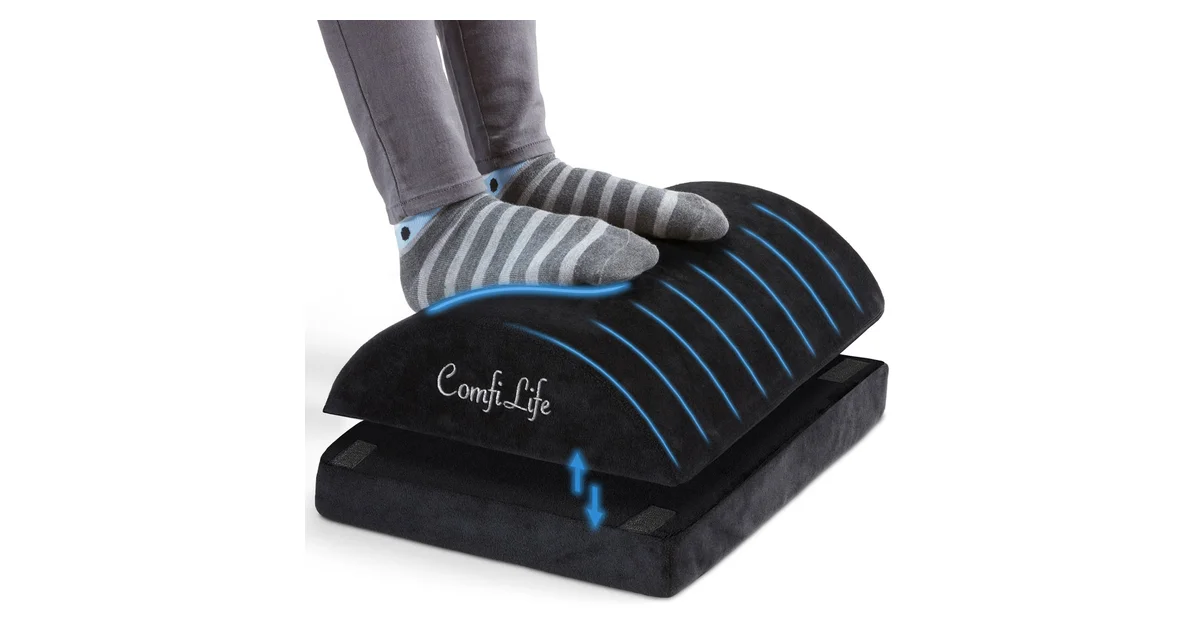
ComfiLife holds the footrest recommendation that most people should buy first. Wirecutter has named it their top pick across multiple review cycles, the only footrest they consistently recommend alongside the Humanscale FM300 (now discontinued). The design is simple to the point of being unremarkable: a high-density memory foam wedge with two height positions achieved by flipping it over. One side gives 4.3 inches of lift. The other gives 6.2 inches. That’s it. No mechanisms. No pedals. No knobs. And for the majority of desk workers, that’s exactly what works.
The numbers back it up. 13,900+ Amazon reviews at 4.6 stars: the second-highest verified review volume in the footrest category behind only the Everlasting Comfort. Wirecutter’s endorsement carries weight because they physically test products and have re-tested footrests across multiple years. BTOD’s Greg Knighton, who personally tested 10 footrests, confirmed the ComfiLife’s foam quality holds up better than most competitors at this price. The lifetime warranty has teeth: ComfiLife’s product page states “no questions asked” money-back or replacement guarantee, which is unusual for a product in the £35 range. If the foam compresses in year two or three, you’re covered.
The foam elevation advantage. Memory foam does something rigid platforms cannot: it conforms to the arch of your foot, distributing pressure across your entire sole instead of concentrating it on the ball and heel. For barefoot or thin-sock home office workers, this is a genuine comfort upgrade over hard plastic. The platform is 17 inches wide by 12.5 inches deep, enough for both feet with room to shift position. The velour cover is machine-washable and unzips fully, which matters when your bare feet are on it eight hours a day. The non-slip bottom keeps the wedge from sliding on hard floors.
The trade-offs: two heights, no gradient. Two height positions are better than one, but they’re not the four or more you get from adjustable platform footrests like the Kensington SmartFit. If neither 4.3 inches nor 6.2 inches matches your body, you’re out of luck. The fixed 15-degree angle works for most users but offers no tilt adjustment. Memory foam compresses over time. BTOD’s testing found that the ComfiLife foam holds up better than the Everlasting Comfort (losing less of its spring-back at 12 to 18 months), but all memory foam degrades. The lifetime warranty mitigates this risk substantially. One practical note: the velour cover attracts lint and pet hair, flagged by ErgonomicsNerd and confirmed across Reddit threads: a vacuum-friendly surface, not a wipe-clean one.
Pros
- Wirecutter’s multi-year top pick: the only footrest they consistently recommend
- 13,900+ Amazon reviews at 4.6 stars: second-highest review volume in category
- Lifetime “no questions asked” warranty: money-back or replacement
- Two height positions (4.3″ or 6.2″) by flipping: no mechanisms to break
- High-density memory foam conforms to foot arches: better pressure distribution than rigid platforms
- Machine-washable velour cover: practical for barefoot daily use
- 17″ × 12.5″ platform accommodates both feet with room to shift
Cons
- Only 2 height positions: if neither matches your body, there’s no adjustment
- Fixed 15-degree angle with no tilt adjustment
- All memory foam degrades: plan on replacement in 2–3 years (warranty covers you)
- Velour cover attracts lint and pet hair: not wipe-clean, needs vacuuming
- Not suitable with street shoes: foam surface wears faster under hard soles
Best for: Most desk workers buying their first footrest: this is the lowest-risk starting point with the strongest third-party endorsement and best warranty. Home-office users who work barefoot or in socks. Anyone who wants plush comfort without spending more than £40. Avoid if: you need precise incremental height adjustment, you wear shoes at your desk and need a wipe-clean hard surface, or neither 4.3″ nor 6.2″ matches your required elevation.
Kensington SmartFit SoleMate Plus: Best Adjustable Platform (Score: 8.5/10)
Price: $40–55 / ~£40 | Type: Adjustable rigid platform (pedal-operated) | Height: 4 positions (~4″–5.9″) | Material: Plastic platform + textured massage-bump surface + anti-slip rubber base | Platform: 17.7″ × 13″ | Warranty: 2-year limited (manufacturing defects)
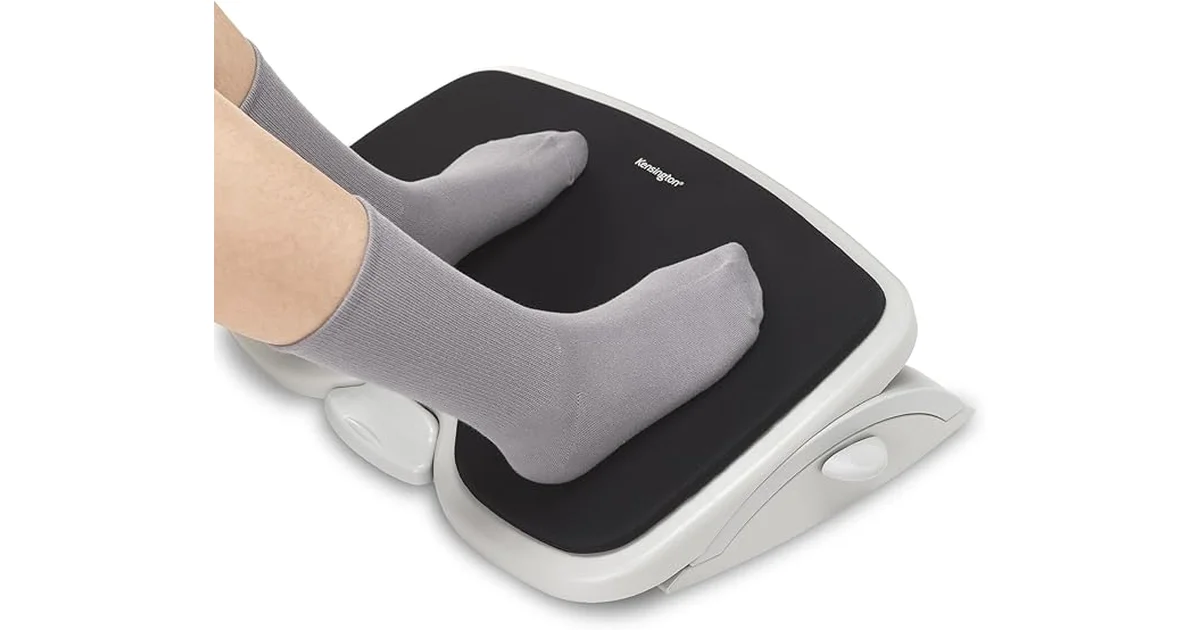
The Kensington SmartFit SoleMate Plus is the footrest for people who want dial-in precision, not plush comfort. Unlike the memory foam options, this is a rigid plastic platform with four stepped height positions, roughly 4 inches to 5.9 inches, adjusted by a foot pedal mechanism. You step on the pedal, lift or lower the platform, release it, and it locks at that height. You never bend down, never look at the unit, never touch anything with your hands. Sound like a small detail? It’s the kind of thing you appreciate by day three of ownership, when adjusting your footrest becomes automatic rather than a chore.
BTOD’s assessment is measured but positive. Founder Greg Knighton personally tested 10 footrests and kept the Kensington in his office rotation, though he preferred foam options for his own barefoot home-office use. The plastic build is utilitarian rather than premium: it scratches cosmetically over 12 to 24 months, and the pedal mechanism can feel slightly stiff after extended use. But for a shoe-wearing office worker who wants precise height control, the SmartFit delivers functionality that foam wedges cannot match. The 17.7-inch by 13-inch platform is wide enough for a natural feet-apart posture.
Surface texture: the shoe/barefoot divide. The entire platform is covered in raised massage bumps. With shoes on, these provide grip and mild stimulation, a net positive. In thin socks or bare feet, they are firm enough to be uncomfortable within an hour. Multiple long-term reviewers across ErgonomicZone and BTOD report that barefoot users end up placing a thin mat or folded towel on top. This is not a defect (the Kensington is designed as an office footrest for shoe-wearing workers), but it’s the single most important detail for home-office buyers to know before purchase. If you work barefoot, skip this and go ComfiLife or ErgoFoam.
Kensington’s 2-year warranty is notably shorter than the lifetime coverage from ComfiLife and Everlasting Comfort. For a £40 product that will see daily foot pressure for years, a longer warranty would be appropriate given the 4.4-star rating across 2,000+ reviews. Kensington’s US and UK support teams are responsive about replacements under warranty, and the unit’s simple construction means there’s less to fail compared to multi-joint adjustable stands. But when competitors at half the price offer lifetime guarantees, a 2-year limit on a foot platform reads as a transparency gap.
Pros
- Hands-free pedal adjustment: change height without bending down or touching anything
- 4 height positions (~4″–5.9″) cover most desk-worker height profiles
- 17.7″ × 13″ platform accommodates a natural feet-apart stance
- Anti-slip rubber base stays put on hardwood, carpet, and tile
- Simple mechanism: less to fail than multi-joint adjustable competitors
- Well-documented across multiple independent ergonomic review sites
Cons
- Massage-bump surface is uncomfortable barefoot or in thin socks: many users add a towel
- 2-year warranty is short for a £40 product: ComfiLife and Everlasting Comfort offer lifetime
- Plastic construction scratches cosmetically within 12–24 months
- Stepped height adjustment (4 positions) rather than continuous: coarser than knob-adjusted competitors
- Pedal mechanism can feel stiff after 1–2 years of daily use
Best for: Office workers who wear shoes at their desk and want precise, tool-free height adjustment without bending under the desk. Anyone who prefers a rigid, stable platform over a soft foam surface. Multi-user workspaces where different people need different footrest heights throughout the day. Avoid if: you work barefoot or in thin socks, you want a soft conforming surface, or you need more than four height positions.
Fellowes Foot Rocker: Best for Active Movement (Score: 8.3/10)
Price: $25–35 / ~£25 | Type: Rocking platform | Height: 2 positions (flip: 2.6″ or 3.7″) | Material: Durable plastic + textured non-slip top + anti-creep tread underside | Platform: 19.3″ × 15.4″, largest in this guide | Warranty: Lifetime (covers defects in materials/workmanship; Fellowes warranty statement explicitly excludes “personal, family, or household purposes,” commercial/contract warranty)
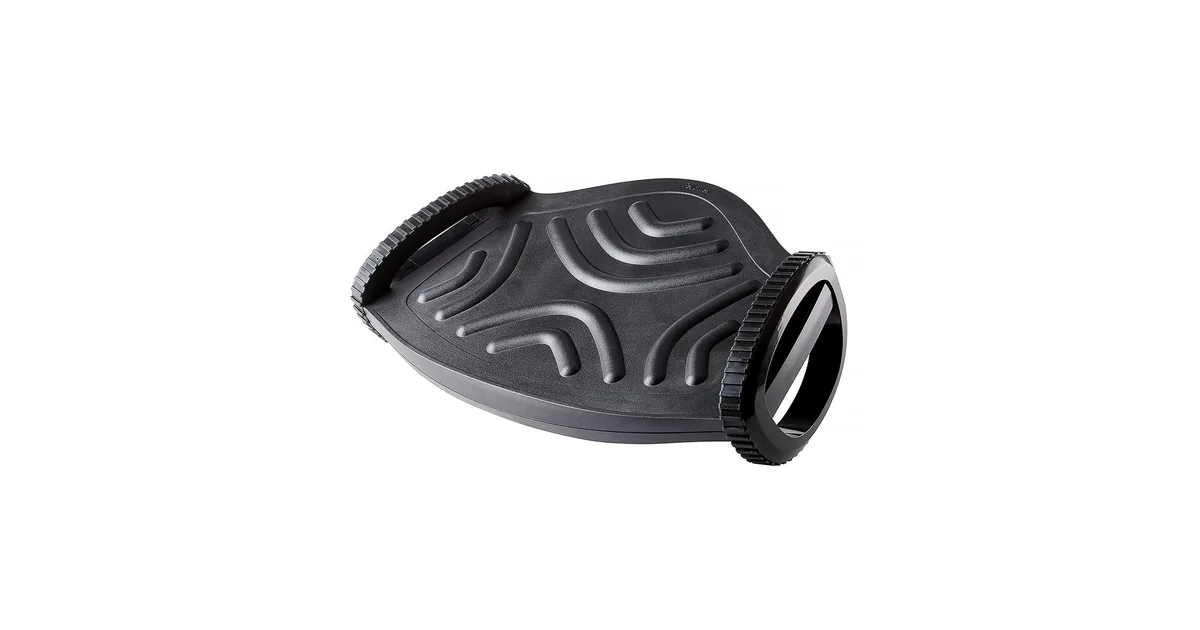
The Fellowes Foot Rocker is the footrest for people who already know they fidget. If you catch yourself tapping your toes, bouncing a knee, or shifting your feet every few minutes during calls, this channels that energy into motion instead of a static hold. Active foot and ankle movement is what drives venous return from the lower legs: a Duplex ultrasound study of 40 limbs found combined active ankle movement produced the highest flow velocities of any movement tested, with mean flow up 38% and peak flow up 58% (Sochart and Hardinge, 1999). The Waongenngarm et al. (2018) review in Applied Ergonomics linked interrupting prolonged sitting to reduced lower back discomfort in office workers. A rocker gets you part of that interruption without standing up. The Fellowes is the most affordable purpose-built rocker that does this.
Size matters here. At 19.3 inches wide by 15.4 inches deep, the Fellowes has the largest platform footprint in this guide, significantly larger than the ComfiLife and Everlasting Comfort memory foam wedges. Both feet sit comfortably with room to shift position throughout the full rocking arc. The anti-creep tread pattern on the underside prevents the unit from slowly walking across the floor during active rocking, a genuinely frustrating problem on cheaper rockers with smooth bottoms. On hardwood floors, the plastic base corners can leave scuff marks unless you add self-adhesive felt pads (a £3 fix).
Height adjustment is as basic as it gets: flip it over. One side gives 2.6 inches of lift. The other gives 3.7 inches. That’s lower than every other footrest in this guide. If you need more height, the Fellowes is the wrong product. It prioritizes rocking motion over elevation. The rocking arc is fixed at roughly 20 degrees with no way to dial resistance up or down and no way to lock the platform flat. This is a rocker first and a platform second. Users who want a stable, non-moving surface should look at the ComfiLife or Kensington instead.
Warranty caveat that matters. Fellowes’ own warranty statement explicitly excludes goods purchased “for personal, family, or household purposes”: the lifetime coverage is a commercial/contract warranty. If you’re buying a single unit for your home office, the warranty protection may be limited compared to the ComfiLife’s “no questions asked” lifetime guarantee. This is a transparency issue worth flagging because most review sites report “lifetime warranty” without reading the fine print. I did. The product itself is well-built and unlikely to fail mechanically (there are no mechanisms to break), but the warranty distinction matters for a purchase you expect to last years.
Pros
- 19.3″ × 15.4″: largest platform footprint in this guide; both feet fit through full rocking arc
- Rocking motion keeps your lower legs moving through long seated sessions: the passive version of a sitting break
- Anti-creep tread underside prevents the unit from walking across the floor
- Instant height swap by flipping: no tools, no mechanisms to break
- Lowest price of any rocking footrest at $25–35 / ~£25
- No electronic components, no hinges: near-zero failure risk over time
Cons
- Only 2 height positions (2.6″ or 3.7″): lowest lift in this guide
- Fixed 20-degree rocking arc: no resistance adjustment, no lock-out for static use
- Plastic corners can scuff hardwood floors without added felt pads
- Fellowes lifetime warranty excludes personal/household use: commercial only (check fine print)
- No cushioning: hard plastic surface is uncomfortable barefoot; works best with shoes
Best for: Active fidgeters who tap or rock their feet while working. Desk workers who sit 6+ hours in a single stretch and want to keep their legs moving without standing up. Anyone who prefers a wide platform with room to shift foot position throughout the day. Shoe-wearing office workers who need moderate elevation (under 4 inches) and want the movement benefit. Avoid if: you need more than 3.7 inches of lift, you want a static lockable platform, you work barefoot and want a soft surface, or the warranty exclusion for household use is a dealbreaker.
ErgoFoam Adjustable: Best Premium Adjustable Foam (Score: 8.2/10)
Price: $42–50 / ~£40 | Type: Adjustable memory foam wedge (2-piece stacking) | Height: 3 positions (4.3″, 5.9″, or 7.5″) | Material: High-density memory foam + machine-washable velvet cover | Platform: 17″ × 13″ (teardrop shape) | Warranty: Lifetime (chiropractor-endorsed brand, covers manufacturing defects)
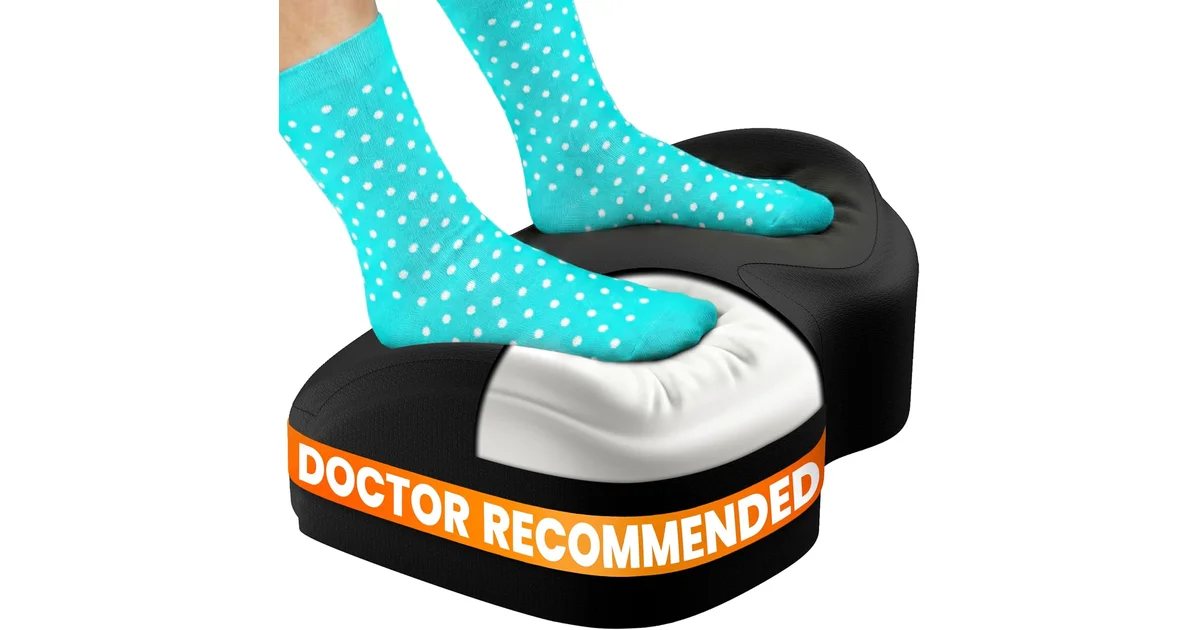
The ErgoFoam solves the ComfiLife’s main limitation, only two height positions, by adding a third. It’s a two-piece stacking system: use the top section alone for 4.3 inches of lift, the bottom section flipped for 5.9 inches, or stack both pieces facing each other for 7.5 inches. Three heights at the same price as the ComfiLife is genuine value, and the 7.5-inch maximum is the highest in this guide, covering shorter users who need substantial elevation to achieve a 90-degree knee angle at standard desk heights. ErgonomicsNerd rated it 9.7/10 and placed it at #1 in their 2026 footrest comparison, specifically citing the multi-height flexibility and chiropractor endorsement.
Two-piece design: clever or fiddly? The stacking mechanism is the ErgoFoam’s defining feature and its main friction point. Two separate foam pieces velcro together. When stacked, the pieces can shift slightly if you reposition your feet aggressively. The Workspace Hero review noted that the pieces occasionally need re-aligning during the day, a minor annoyance that doesn’t affect comfort but means the ErgoFoam requires more attention than a single-piece foam wedge. The velcro attachment is secure enough for normal use but won’t survive being kicked or dragged across the floor. For a desk setup where the footrest stays in one place and you’re the only user, the two-piece design is a functional way to get three heights from memory foam. For a multi-user workspace where the footrest gets moved, it’s a liability.
Foam quality and cover practicalities. The memory foam is higher density than the Everlasting Comfort, closer to the ComfiLife’s density, and holds its shape better over time. The velvet cover feels more premium than the Everlasting Comfort’s standard fabric but attracts lint and pet hair aggressively, as ErgonomicsNerd noted in their review. The cover is machine-washable. Available in multiple colours (black, grey, blue, pink), a minor aesthetic point that matters if your home office has a specific colour scheme and a black foam wedge doesn’t fit.
UK availability note. ErgoFoam maintains a dedicated UK Amazon presence (ASIN B07PWT8X6K) and their own UK-facing site. The US Amazon listing (ASIN B08DS3KG1G) is a slightly different model variant: the teardrop-style adjustable rather than the flat-top. Both are genuine ErgoFoam products. Pricing is similar across regions at $42–50 / ~£40. The lifetime warranty covers manufacturing defects; as with all memory foam warranties, natural compression over time may fall outside coverage. ErgoFoam’s specific warranty terms should be checked on their site before purchase.
Pros
- 3 height positions (4.3″, 5.9″, 7.5″): most adjustable foam footrest in this guide
- 7.5″ maximum height: highest lift available, covers shorter users who need substantial elevation
- High-density memory foam: better shape retention than Everlasting Comfort
- #1 rated on ErgonomicsNerd (9.7/10): strong third-party expert endorsement
- Machine-washable velvet cover: multiple colour options
- Lifetime warranty: chiropractor-endorsed brand
- Available in both US and UK Amazon stores
Cons
- Two-piece stacking design: pieces can shift during use and need occasional re-alignment
- Velcro attachment secure enough for stationary use but not for frequent moving/kicking
- Velvet cover attracts lint and pet hair aggressively: needs more maintenance than velour
- All memory foam compresses over time: natural wear isn’t covered by warranty
- US and UK models differ slightly (B08DS3KG1G vs B07PWT8X6K): check correct listing
Best for: Users who need three or more height options but prefer memory foam comfort over a rigid plastic platform. Shorter desk workers who require 5+ inches of elevation: the 7.5-inch maximum is the highest available. Anyone who found the ComfiLife’s two positions limiting but wants the same foam feel. Avoid if: you want a single-piece footrest with no moving parts, you need a wipe-clean hard surface, or you frequently move your footrest between workstations.
Everlasting Comfort Memory Foam: Best Budget Comfort (Score: 8.0/10)
Price: $29 / ~£25 | Type: Fixed memory foam teardrop cushion | Height: Fixed ~4.7″ (teardrop shape) | Material: 100% pure memory foam + machine-washable zippered cover | Platform: 17″ × 9.5″ (teardrop shape) | Warranty: Lifetime (manufacturing defects, does not cover natural foam compression)
The Everlasting Comfort holds the largest verified review volume of any footrest I could confirm: 28,069 Amazon reviews at a 4.3/5 adjusted rating (Nullfake review analysis). That’s double the nearest competitor. At $29 / ~£25, it’s the lowest-risk entry point in the category, and it’s BTOD founder Greg Knighton’s personal home-office choice among budget footrests. The formula is simple: a teardrop-shaped block of 100% pure memory foam with no fillers, a removable machine-washable zippered cover, and a non-slip textured bottom. Flip it over and the curved underside functions as a gentle rocker: two use modes for one price.
The foam is genuinely soft. This is the single most comfortable footrest surface for barefoot users. The memory foam contours to your foot arches and distributes pressure across your heels, something a rigid plastic or wood platform physically cannot replicate. The teardrop shape is designed to cradle your arches rather than providing a flat elevated surface. The cover zips off and machine-washes. For a home-office setup where you work barefoot, in slippers, or in thin socks eight hours a day, the comfort difference between this and a hard platform is immediate and obvious.
The compression problem is real and universal to memory foam. BTOD’s long-term testing found that Everlasting Comfort foam loses roughly 30% of its initial spring-back within 12 to 18 months of daily use. This is not a defect specific to Everlasting Comfort: all memory foam degrades under sustained pressure. But the Everlasting Comfort’s degradation is more pronounced than the denser ComfiLife foam, and the lifetime warranty explicitly covers manufacturing defects, not natural foam compression. That distinction matters: the actual failure mode (compression from use) is not what the warranty covers. At £25, this product is priced as a consumable comfort item with a ~2-year lifespan, not a permanent ergonomic investment. For the price of two Everlasting Comforts replaced over four years, you could buy one ComfiLife with a warranty that actually covers replacement.
Heat and shape limitations. The foam is heat-responsive, meaning it softens with body warmth. In a climate-controlled office, this creates a custom-contoured feel. In a warm room without air conditioning, the foam can become excessively soft and lose its supportive structure, a complaint that surfaces consistently across Amazon reviews and Reddit threads. The teardrop shape is designed for one foot position (both feet together in front of you). Users who prefer feet apart or shifted to one side will find the shape restrictive. The fixed height and fixed angle mean there’s zero adjustability: if 4.7 inches of lift doesn’t match your body, this footrest cannot adapt.
Pros
- 28,069 Amazon reviews at 4.3/5 adjusted: largest verified review volume in the category
- Softest footrest surface available: 100% pure memory foam, no fillers
- Lowest entry price in this guide at $29 / ~£25
- Machine-washable zippered cover: practical for barefoot daily use
- Dual-mode: upright as stationary pad, flipped as gentle rocker
- Non-slip textured bottom stays put on hard floors
- BTOD founder’s personal home-office choice among budget footrests
Cons
- Foam loses ~30% spring-back within 12–18 months of daily use: BTOD documented
- Lifetime warranty excludes natural foam compression: the actual failure mode
- Fixed height (~4.7″) and fixed angle: zero adjustability
- Heat-responsive foam becomes overly soft in warm rooms, losing support
- Teardrop shape restricts foot positioning: designed for feet-together posture
- Zipper on underside can scratch hardwood floors
Best for: Barefoot home-office workers who prioritize plush comfort above all else. Budget-conscious first-time buyers at the £25 price point who understand this is a ~2-year consumable, not a permanent purchase. Anyone in a climate-controlled room who won’t experience the heat-softening issue. Avoid if: you need any height or angle adjustability, you work in a warm room, you wear shoes at your desk, or you want a footrest that lasts beyond two years without compressed foam.
Comparison Table: All 5 Footrests at a Glance
| Product | Score | Price (UK/US) | Type | Material | Height Positions | Platform | Warranty | Best For |
|---|---|---|---|---|---|---|---|---|
| ComfiLife | 8.8/10 | $35–60 / ~£35 | Memory foam wedge | High-density memory foam | 2 (flip: 4.3″ or 6.2″) | 17″ × 12.5″ | Lifetime* | First-time buyers, most desk workers |
| Kensington SmartFit | 8.5/10 | $40–55 / ~£40 | Adjustable rigid platform | Rigid plastic + rubber base | 4 (pedal: ~4″–5.9″) | 17.7″ × 13″ | 2-year | Shoe-wearing office workers, precision adjustability |
| Fellowes Foot Rocker | 8.3/10 | $25–35 / ~£25 | Rocking platform | Rigid plastic + tread top | 2 (flip: 2.6″ or 3.7″) | 19.3″ × 15.4″ | Lifetime (commercial only)** | Active fidgeters, all-day sitters |
| ErgoFoam | 8.2/10 | $42–50 / ~£40 | Stacking memory foam | High-density memory foam | 3 (stack: 4.3″, 5.9″, 7.5″) | 17″ × 13″ | Lifetime* | Need 3+ heights + foam comfort, shorter users |
| Everlasting Comfort | 8.0/10 | $29 / ~£25 | Fixed memory foam cushion | Pure memory foam | 1 (fixed ~4.7″) | 17″ × 9.5″ | Lifetime (defects only)* | Barefoot comfort, lowest budget |
* Lifetime foam warranties typically cover manufacturing defects, not natural compression from use. ComfiLife’s warranty states “no questions asked”: the strongest consumer protection. ** Fellowes lifetime warranty explicitly excludes personal/household use (commercial/contract warranty only). Review counts: ComfiLife 13,900+ at 4.6/5; Kensington ~2,000+ at 4.4/5; Fellowes ~600+ at 4.2/5; ErgoFoam ~1,000+ at 4.5/5; Everlasting Comfort 28,069 at 4.3/5 adjusted (Nullfake). All prices approximate. Amazon pricing fluctuates daily.
Bamboo vs Foam vs Rigid Plastic: Which Footrest Material Lasts?
Footrest materials do two different jobs, and you only get to pick one. Foam cushions and compresses. Bamboo, plastic and other rigid materials hold their height and never compress. Which one you want depends on your footwear and how long the footrest sits under load.
Foam quality is a density question. Humanscale rates high-density foam at 2.8 PCF and above, against low-density foam that can sit near 1.5 PCF, and notes that denser foam contains more material and holds up longer. Polyurethane foam also suffers compression set: repeated loading reduces its rebound capacity and increases permanent deformation (Concept Seating). That is the 12-to-18-month mark where the foam picks above start losing spring-back.
Bamboo works the other way. It is a grass that gets laminated and pressed into boards, and its tensile strength reaches roughly 28,000 psi, above oak and maple, with compressive strength higher than wood, brick or concrete (Stikwood). A bamboo footrest will hold its height indefinitely and will not pack down. What it will not do is give.
So the question is not which material is better. Barefoot at a desk for eight hours, foam wins, because the give is the point. In shoes, or if you have already flattened a foam footrest, rigid wins, whether that is bamboo or the plastic platforms the Kensington and Fellowes picks use.
What owners report after a year
Owner reports split along the same line. Foam complaints cluster at the 12-to-18-month point. Everlasting Comfort and ErgoFoam cover manufacturing defects but not compression, the failure foam actually suffers. ComfiLife is the outlier with a no-questions-asked warranty. Rigid complaints are about surfaces rather than support: the Fellowes plastic base corners will scuff hardwood unless you add felt pads.
| Material | Cushions? | Holds height? | Typical failure | Best for |
|---|---|---|---|---|
| Memory foam | Yes | Until it compresses | Spring-back loss at 12-18 months | Barefoot use, comfort first |
| High-density foam | Yes | Longer than standard foam | Same, but slower | Barefoot, want it to last |
| Bamboo | No | Indefinitely | None under normal load | Shoes, fixed height, longevity |
| Rigid plastic | No | Indefinitely | Scuffs hard floors, surface wear | Shoes, adjustable platforms |
What to Look For When Buying an Ergonomic Footrest in 2026
Measure first, buy second. Sit at your desk with your chair adjusted so your elbows rest at desk height and your shoulders are relaxed. Look down. Is there a gap between your feet and the floor? Measure it: a ruler from the bottom of your heel to the floor. That’s the lift you need. Under 2 inches: you may not need a footrest at all. 2 to 4 inches: the Fellowes or ComfiLife (low setting) will work. 4 to 6 inches: ComfiLife (high setting), Kensington (mid settings), or ErgoFoam (mid settings). Over 6 inches: ErgoFoam (highest setting at 7.5 inches) or the Kensington at its top position. Users under roughly 165 cm (5-foot-5) typically need 4 to 6 inches of lift. Taller users may only need 2 to 3 inches. These are ranges: measure, don’t guess.
Foam vs. rigid platform: your footwear decides this for you. If you work barefoot, in socks, or in slippers at home, buy a foam footrest. Memory foam conforms to your foot arches and distributes pressure. Rigid plastic or wood surfaces feel cold and hard on bare skin within minutes. If you wear shoes at your desk, a rigid adjustable platform (Kensington) will serve you better, last longer, and be easier to wipe clean. Memory foam compresses faster under hard-soled shoes. Street shoes on a £25 foam wedge will destroy it within a year. Match the surface to how you actually work, not how you imagine you should work.
Rocking vs. stationary: how long do you sit in one stretch? Foot and ankle movement is what clears blood from the lower legs during a long seated stretch. The Waongenngarm et al. (2018) review in Applied Ergonomics linked interrupting prolonged sitting to reduced lower back discomfort in office workers. If you sit for 6+ hours in a single stretch, a rocking footrest (Fellowes) or a foam wedge you can flip into rocker mode (Everlasting Comfort) gives you that movement without you having to stand up. If you sit for 3 hours or fewer per stretch, or you simply prefer a perfectly stable base, a stationary platform or fixed foam wedge is fine. Active fidgeters will love the Fellowes. People who value stability above movement will prefer the ComfiLife or Kensington.
Adjustability: more positions isn’t always better, but too few is useless. One fixed height works only if it happens to match your body exactly. Two heights (ComfiLife, Fellowes) cover most users. Three (ErgoFoam) adds headroom for shorter users who need the maximum 7.5-inch lift. Four (Kensington) adds granularity for multi-user spaces where different people need different settings throughout the day. The number of positions you need depends on whether you’re the only user or sharing the workspace. If it’s just you and you know your required height, two positions that bracket your measurement are perfectly adequate.
Warranties: read the actual terms, not the headline. Every foam footrest in this guide advertises a “lifetime warranty.” The fine print differs dramatically. ComfiLife’s “no questions asked” money-back or replacement guarantee is the strongest consumer protection: they explicitly promise to replace or refund regardless of the reason. Everlasting Comfort and ErgoFoam cover manufacturing defects but not natural foam compression (the actual failure mode). Fellowes’ lifetime warranty explicitly excludes personal and household use: it’s a commercial/contract warranty, not a consumer one. Kensington’s 2-year warranty is the shortest but covers what it says. Before buying a footrest marketed as “lifetime warranty,” find the actual warranty page and check whether compression from use (the thing foam footrests actually do over time) is covered.
Knee angle is the target; footrest height is just the tool. The ergonomic goal is a 90 to 110 degree knee angle with your feet fully supported and your thighs parallel to the floor. The footrest is the tool that achieves this angle when your chair height is correct for desk work. CCOHS’s chair adjustment guidelines and ISO 9241-5 both specify full foot support as a requirement for neutral seated posture. If your chair can lower enough that your feet rest flat on the floor while your elbows stay at desk height, you don’t need a footrest, and adding one would push your knees too high, creating a new problem. A footrest is a solution to a specific geometric mismatch, not a universal ergonomic upgrade. Adjust your chair first. Measure the gap second. Buy the footrest third.
Once your foot support is sorted, the rest of the workspace matters just as much. See our complete best home office setup guide for monitor placement, desk ergonomics and cable routing.
Sources
- Wirecutter (NYT): The 2 Best Under-Desk Footrests of 2026
- BTOD: Best Ergonomic Footrests Comparison (10 footrests, hands-on tested)
- CCOHS: Office Ergonomics: Chair Adjusting Guidelines
- OSHA: eTools Computer Workstations: Desk Components
- ISO 9241-5: Ergonomics of human-system interaction, Part 5: Workstation layout and postural requirements
- WorkSmartHub: Footrest Ergonomics: Evidence-Based Selection Guide
- ComfiLife: Foot Rest Official Product Page (Lifetime Warranty Terms)
- ErgoFoam: Adjustable Foot Rest Official Specifications
- Kensington: SmartFit SoleMate Plus Official Specifications
- Fellowes: Smart Suites Standard Foot Rocker Official Product Page
- Fellowes: Official Warranty Statement
- Kensington: SmartFit SoleMate Warranty Terms (2-Year Limited)
- Knowledgelib: 7-Source Office Footrest Aggregation (2026)
- Nullfake: Everlasting Comfort Amazon Review Authenticity Analysis
- Waongenngarm, P., Areerak, K., & Janwantanakul, P. (2018). The effects of breaks on low back pain, discomfort, and work productivity in office workers: A systematic review of randomized and non-randomized controlled trials. Applied Ergonomics, 68, 230–239.
- Sochart, D. H., & Hardinge, K. (1999). The relationship of foot and ankle movements to venous return in the lower limb. The Journal of Bone and Joint Surgery. British Volume, 81(4), 700–704.
- Humanscale: Why Higher Density Foam is Better for Task Chairs
- Concept Seating: Predicting Foam Degradation in 24/7 Office Chairs
- Stikwood: How Strong is Bamboo? Exploring Strengths and Benefits
The Verdict
Most desk workers do not need a £100+ footrest. The ComfiLife Adjustable Memory Foam ($35–60 / ~£35) is the strongest recommendation here: Wirecutter has re-tested it across multiple years and kept it as their top pick each time, BTOD's Greg Knighton confirmed the foam holds up better than competitors, and the lifetime "no questions asked" warranty removes the risk of compression-related replacement. For the price of a single takeaway meal, the Everlasting Comfort ($29 / ~£25) delivers the softest barefoot surface of any footrest available, but know that the foam loses about 30% of its structure in roughly 18 months and the lifetime warranty won't cover it. The ErgoFoam ($42–50 / ~£40) earns its slot by solving the ComfiLife's main limitation: three height positions instead of two, with a 7.5-inch maximum that covers shorter users who need more elevation. Shoe-wearing office workers who want dial-in precision and hands-free adjustment should grab the Kensington SmartFit ($40–55 / ~£40): the foot-pedal mechanism is genuinely useful and the rigid platform won't compress under hard soles. Active fidgeters: the Fellowes Foot Rocker ($25–35 / ~£25) is the largest, simplest rocker available, and the research supports its benefit for circulation. Measure your gap first, chair to foot, before choosing anything. If your feet already rest flat on the floor, no footrest will improve your posture and adding one could push your knees too high.
← Back to Best Picks Hub