Discover the best keyboard shortcuts for productivity for Windows and Mac in 2026. Learn time-saving shortcuts for multitasking, screenshots, file management, search, browsing, and faster everyday work.
Table of Contents
- In a hurry? Start with these 10 must-know productivity shortcuts
- Windows vs Mac keyboard shortcut cheat sheet
- Best keyboard shortcuts for everyday productivity
- Editing shortcuts that save time every day
- Search and launch shortcuts
- App switching and task flow
- Best browser keyboard shortcuts for faster web work
- Tab management shortcuts
- Navigation and page search shortcuts
- Best file management keyboard shortcuts
- Open file managers and organize faster
- Select, move, and manage items efficiently
- Best multitasking and window management shortcuts
- Window snapping, desktops, and screen space
- Show desktop, minimize clutter, stay focused
- Best screenshot shortcuts for work and troubleshooting
- Capture exactly what you need
- Use screenshots for communication
- Windows to Mac shortcut equivalents
- Control vs Command and other common swaps
- Why some shortcuts vary
- How keyboard layout and hardware affect shortcut speed
- Compact keyboards, MacBook layouts, and function rows
- Choose gear that supports keyboard-first work
- How to remember keyboard shortcuts and actually use them
- Start with five, then build by workflow
- Consistency beats quantity
- Conclusion
- Frequently Asked Questions
In a hurry? Start with these 10 must-know productivity shortcuts
The best keyboard shortcuts for productivity are the ones you can use dozens of times a day without stopping to think. In both Windows and Mac, the right mix of editing, search, multitasking, file management, and screenshot shortcuts can remove a surprising amount of friction from routine work. Instead of reaching for the mouse every few seconds, you stay in flow, switch apps faster, manage windows more cleanly, and finish repetitive tasks with less effort.
This guide covers the best keyboard shortcuts for productivity in Windows and Mac for 2026, with a practical focus on the commands that actually save time during daily work. Rather than listing every obscure shortcut available, it concentrates on the combinations that matter most for writing, research, office tasks, browsing, screenshots, and general multitasking. The shortcuts below were selected using official Microsoft and Apple references, then grouped by real-world use case so the article reads like a productivity guide rather than a raw cheat sheet.
If you only learn a handful of keyboard shortcuts this year, start with copy, paste, undo, search, app switching, screenshots, and window management. Those are the shortcuts that usually pay back immediately. Once those feel natural, you can add more advanced productivity shortcuts for virtual desktops, quick search, and file handling.
| Action | Windows | Mac | Why it matters |
|---|---|---|---|
| Copy / Paste | Ctrl + C / Ctrl + V | Command + C / Command + V | Still the fastest way to move text, links, images, and files. |
| Undo / Redo | Ctrl + Z / Ctrl + Y | Command + Z / Shift + Command + Z | Essential when writing, editing, or correcting mistakes. |
| Find on page | Ctrl + F | Command + F | Speeds up research, editing, and browsing. |
| Switch apps | Alt + Tab | Command + Tab | Moves between open apps without breaking concentration. |
| Search | Windows + S | Command + Space | Launch apps, find files, and start tasks quickly. |
| Screenshot | Windows + Shift + S | Shift + Command + 4 | Captures exactly what you need for notes, tickets, or reports. |
| Select all | Ctrl + A | Command + A | Useful in documents, folders, and forms. |
| New tab | Ctrl + T | Command + T | Core browser shortcut for research-heavy workflows. |
| Close tab/window | Ctrl + W | Command + W | Keeps clutter under control. |
| Lock screen | Windows + L | Control + Command + Q | Improves privacy instantly in shared spaces. |
These shortcuts cover the core actions behind most computer-based work. If your goal is better productivity in Windows and Mac, this is the highest-value starting set.
👉 Read the guide: 10 Powerful Ways a Keyboard & Mouse Setup Can Transform Your Productivity
Windows vs Mac keyboard shortcut cheat sheet
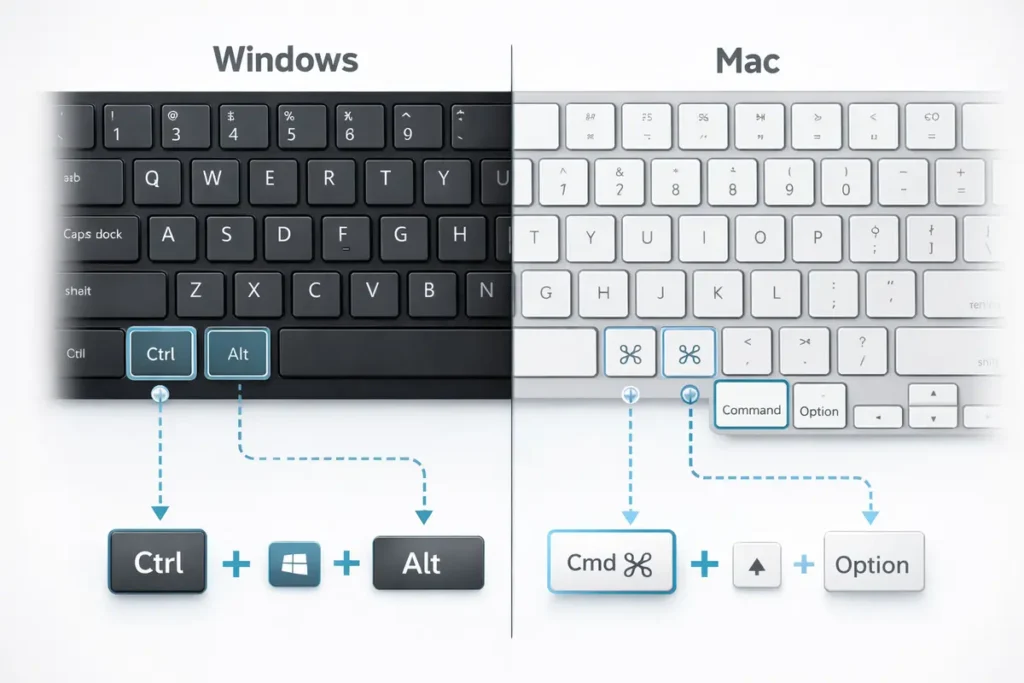
Many productivity shortcuts follow the same logic across Windows and Mac, but the modifier keys differ. On Windows, Control and Alt do much of the heavy lifting. On Mac, Command and Option take over many of the same roles. Learning the equivalents side by side makes it much easier to switch between systems or use both at work.
| Task | Windows shortcut | Mac shortcut | Notes |
|---|---|---|---|
| Copy | Ctrl + C | Command + C | Almost universal across apps. |
| Paste | Ctrl + V | Command + V | Same behavior in most apps. |
Cut | Ctrl + X | Command + X | Common editing shortcut. |
| Select all | Ctrl + A | Command + A | Works in text fields and folders. |
| Find | Ctrl + F | Command + F | Useful in browsers and documents. |
| Switch apps | Alt + Tab | Command + Tab | Core multitasking shortcut. |
| Search | Windows + S | Command + Space | Best shortcut for launching apps quickly. |
| Screenshot area | Windows + Shift + S | Shift + Command + 4 | Great for support, notes, and tutorials. |
| Close window/tab | Ctrl + W | Command + W | Helpful for browser and document cleanup. |
| Quit app | Alt + F4 | Command + Q | Mac closes the app, not just the window. |
Best keyboard shortcuts for everyday productivity
Editing shortcuts that save time every day
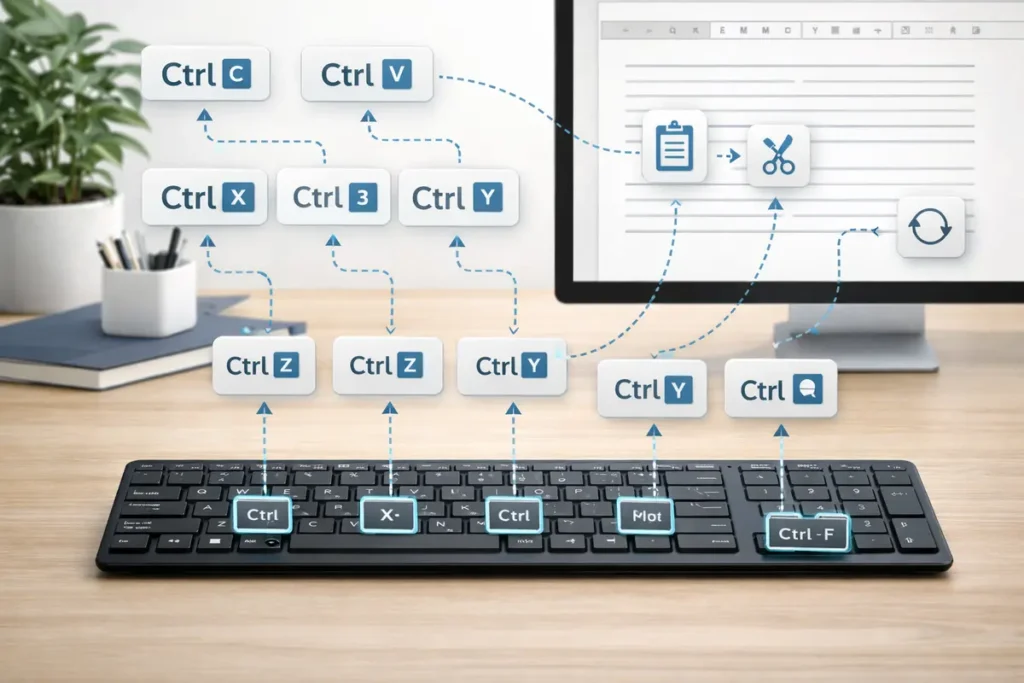
The most useful keyboard shortcuts for productivity are usually basic editing commands used over and over again. Copy, paste, cut, undo, redo, select all, and find are not flashy, but they save time in nearly every app. In Windows, Ctrl-based shortcuts dominate this category. In Mac, the Command key is the main modifier. These shortcuts matter because they remove tiny delays from writing, email, spreadsheets, research notes, and content work. Repeating a command with a shortcut is almost always faster than moving to a menu or right-clicking with a mouse.
Search and launch shortcuts
Search is one of the best productivity shortcuts on both platforms. On Windows, Windows + S opens search so you can start typing an app, file, setting, or document name immediately. On Mac, Command + Space opens Spotlight, which is excellent for launching apps, finding files, doing quick calculations, and jumping into system actions. For most users, this shortcut alone can replace a lot of unnecessary menu navigation.
App switching and task flow
Alt + Tab on Windows and Command + Tab on Mac are among the best keyboard shortcuts for productivity because they keep you moving between active tasks. Instead of visually hunting for open windows, you cycle through what is already running. This is especially useful for anyone switching constantly between a browser, notes app, chat tool, file manager, and office documents.
Best browser keyboard shortcuts for faster web work
Tab management shortcuts
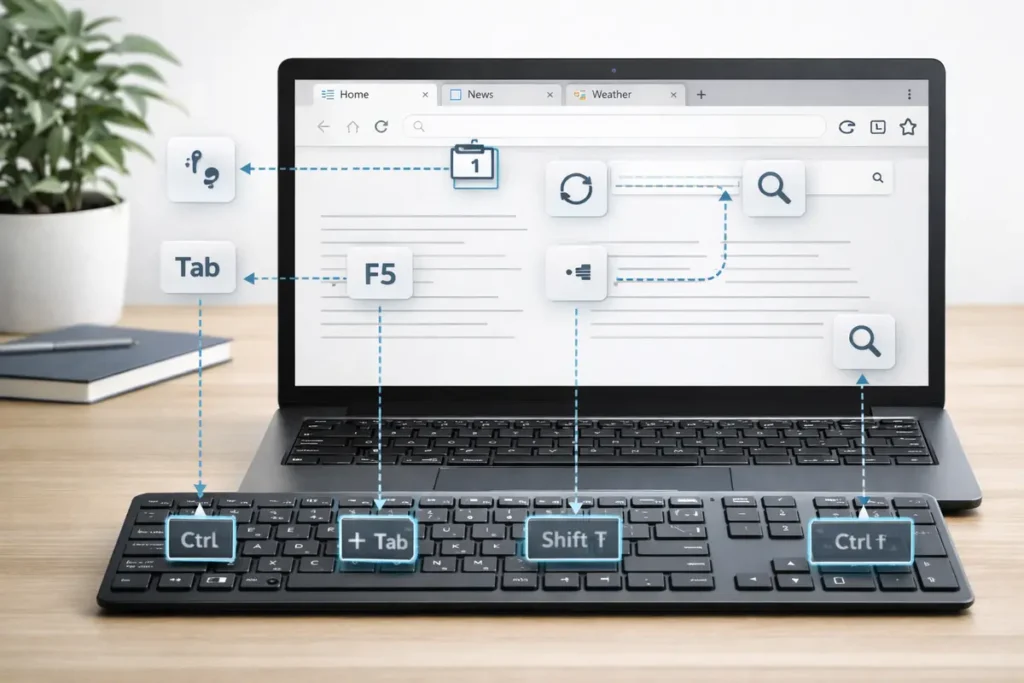
Browser shortcuts are essential for research, content writing, shopping comparisons, and day-to-day office work. Ctrl + T or Command + T opens a new tab, Ctrl + W or Command + W closes the current tab, and Ctrl + Shift + T or Shift + Command + T reopens a closed tab. If you regularly work with many tabs, these productivity shortcuts can save more time than almost any other group.
Navigation and page search shortcuts
Ctrl + L on Windows or Command + L on Mac moves focus to the address bar so you can paste or type a new URL quickly. Ctrl + F or Command + F finds text on the current page. Refresh commands such as Ctrl + R or Command + R are also useful when checking dashboards, search results, or web tools that update often.
Best file management keyboard shortcuts
Open file managers and organize faster
Windows + E opens File Explorer instantly, while Command + N in Finder opens a new Finder window. Rename, delete, create new folders, and move between directories become much faster when you rely on keyboard shortcuts instead of repeated mouse movements. In Windows, Shift + Delete can permanently delete selected items, while on Mac, Command + Delete moves items to the Trash. These shortcuts are useful for anyone working with downloads, external drives, screenshots, and project folders.
Select, move, and manage items efficiently
Good file management shortcuts improve both speed and accuracy. Selecting all items, opening search, previewing content, and renaming files are repetitive actions that become smoother with keyboard-first habits. This is also where keyboard quality matters: a comfortable layout, clear modifier keys, and a reliable function row all help when you use productivity shortcuts heavily every day.
Best multitasking and window management shortcuts
Window snapping, desktops, and screen space
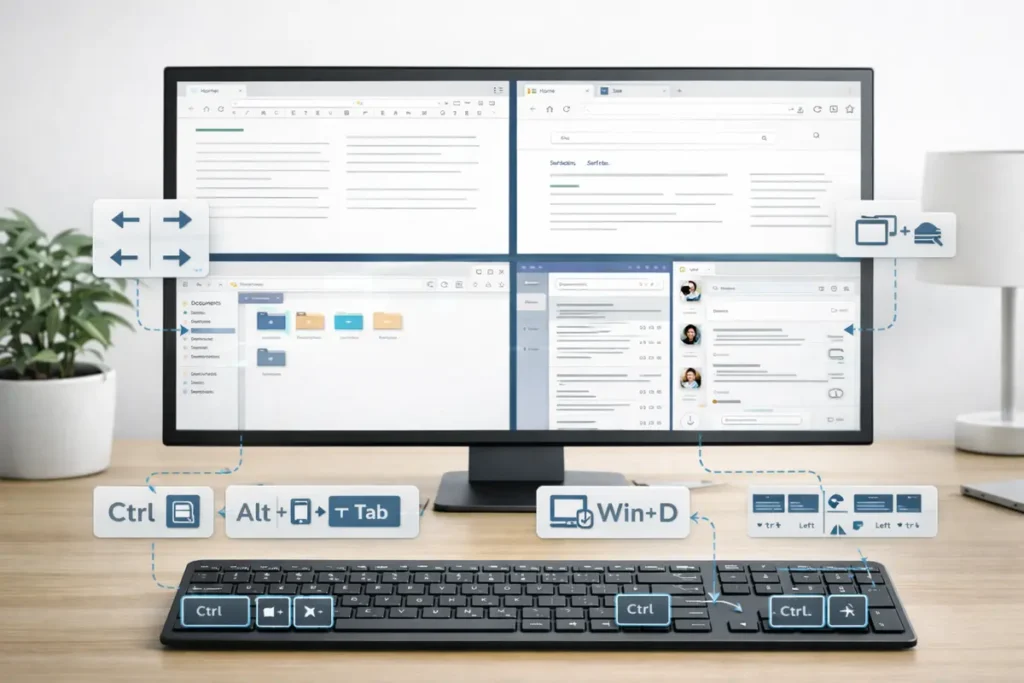
Window management shortcuts are some of the most underrated productivity shortcuts in Windows and Mac. In Windows, shortcuts such as Windows + Left Arrow and Windows + Right Arrow help snap windows into place for split-screen work. Windows + Ctrl + D creates a new virtual desktop, which is handy for separating research, communication, and creative tasks. On Mac, Mission Control, app switching, and desktop shortcuts help achieve the same clean workflow, even if the exact key combinations differ by setup and system preferences.
Show desktop, minimize clutter, stay focused
The more open windows you have, the more important keyboard shortcuts become. A fast way to show the desktop, reduce distractions, or move between full-screen apps makes your setup feel faster than it really is. This is where productivity is not only about speed but also about reducing mental clutter.
Best screenshot shortcuts for work and troubleshooting
Capture exactly what you need
Screenshot shortcuts are a high-value category because they support work across email, IT support, troubleshooting, design feedback, documentation, and social media. On Windows, Windows + Shift + S opens the Snipping Tool overlay so you can capture a selected area. On Mac, Shift + Command + 4 captures a selected region, while Shift + Command + 3 grabs the entire screen. These are some of the best keyboard shortcuts for productivity because they make it faster to capture and share what you see.
Use screenshots for communication
A quick screenshot often explains a problem faster than a paragraph of text. For help desk tickets, browser research, product comparisons, and workflow tutorials, screenshot shortcuts save time and reduce misunderstandings. That makes them especially relevant for an IT gear site, where visual explanations matter.
Windows to Mac shortcut equivalents
Control vs Command and other common swaps
One of the main frustrations when moving between platforms is muscle memory. On Windows, Ctrl handles most common editing commands. On Mac, Command replaces it for many of the same actions. Alt + Tab becomes Command + Tab, Windows + S becomes Command + Space, and Alt + F4 lines up more closely with Command + Q than with Command + W. Explaining these equivalents clearly makes the article more useful than a simple list of shortcuts.
Why some shortcuts vary
Some keyboard shortcuts vary by app, keyboard layout, and system settings. That is normal. Apple notes that shortcuts can differ depending on the app and keyboard layout, while Microsoft also notes that some shortcuts can behave differently across applications. That is why a strong productivity guide should focus on the most consistent shortcuts first, then mention that exceptions exist.
How keyboard layout and hardware affect shortcut speed
Compact keyboards, MacBook layouts, and function rows
For an IT gear audience, hardware is part of the story. A compact keyboard can be excellent for desk space and portability, but some users work faster on a full-size board with dedicated function keys and a clearer physical separation between modifiers. MacBook keyboards, compact mechanical keyboards, and Windows laptop layouts can all influence how easy it is to use productivity shortcuts confidently.
Choose gear that supports keyboard-first work
If you use keyboard shortcuts for productivity all day, pay attention to key spacing, switch feel, function key access, and the comfort of the Command, Control, Alt, and Windows keys. Good hardware does not replace technique, but it can make repeated shortcuts more comfortable and more accurate over time.
How to remember keyboard shortcuts and actually use them
Start with five, then build by workflow
The easiest way to learn keyboard shortcuts is to start small. Pick five shortcuts you will use every day: copy, paste, undo, search, and app switching are usually the best first set. Once those become automatic, add screenshot shortcuts, browser shortcuts, and window management shortcuts. Learning by workflow is more effective than memorizing a giant list at once.
Consistency beats quantity
You do not need to know a hundred shortcuts to see a real benefit. Ten well-chosen productivity shortcuts used consistently will do more for your speed than a huge list you never remember. That is why the best keyboard shortcuts for productivity are the ones that solve common daily problems first.
Conclusion
The best keyboard shortcuts for productivity in Windows and Mac are not necessarily the most advanced ones. The biggest gains usually come from a reliable core: editing shortcuts, search shortcuts, app switching, browser tab control, screenshots, and smarter window management. Once those are in your fingers, your computer feels faster because your workflow becomes simpler. For most readers, the best next step is to learn five shortcuts today, use them for a week, and then add another five. That steady approach turns a list of shortcuts into a real productivity system.
Frequently Asked Questions
The best keyboard shortcuts for productivity are the ones used constantly in daily work: copy, paste, undo, find, app switching, search, screenshots, and tab management.
Windows + S is one of the most useful because it opens search instantly and helps you launch apps, files, and settings without hunting through menus.
Command + Space is one of the most useful Mac keyboard shortcuts because Spotlight lets you open apps, find files, and start actions quickly.
Many shortcuts follow the same logic, but the modifier keys are different. Windows often uses Ctrl and Alt, while Mac usually uses Command and Option.
The Mac equivalent of Ctrl + C is Command + C.
The Mac equivalent of Ctrl + V is Command + V.
The closest Windows equivalent is Windows + S for Search.
Alt + Tab on Windows and Command + Tab on Mac are the most important multitasking shortcuts, followed by window and desktop management shortcuts.
Windows + Shift + S is the best all-round screenshot shortcut because it lets you capture only the area you need.
Shift + Command + 4 is one of the best Mac screenshot shortcuts because it captures a selected region quickly.
Yes. New tab, close tab, reopen closed tab, find on page, and address bar shortcuts are some of the most useful time-saving commands for research and web work.
Yes. Even a small set of shortcuts can save time every day in email, documents, spreadsheets, browsers, and file management.
Start with five to ten high-value shortcuts and use them daily before adding more.
Yes. Some shortcuts are system-wide, while others change depending on the app, keyboard layout, or settings
They can for some users, especially if function keys or modifier keys are cramped, but a well-designed compact keyboard can still work very well.
Ctrl + F on Windows and Command + F on Mac are the standard find commands in browsers and many apps.
Alt + Tab on Windows and Command + Tab on Mac are the fastest standard ways to switch between open apps.
Windows + L locks a Windows PC, while Control + Command + Q locks a Mac.
Absolutely. Students benefit from faster note-taking, research, tab management, screenshots, and document editing in the same way professionals do.
A good productivity keyboard has a comfortable layout, clear modifier keys, reliable switches or key feel, and function keys that are easy to reach when needed.
References
Microsoft Support: Keyboard shortcuts in Windows
Apple Support: Mac keyboard shortcuts
Google Search Central: Creating helpful, reliable, people-first content